5G boosts Mobile Private Networks for IoT
Published on: 20/01/2026

7 mn reading time
5G Mobile Private Networks (MPNs) offering ultra-low latency and high data throughput are becoming increasingly attractive for companies looking to support IoT applications, such as AI computer vision, robotics, and autonomous vehicles in Industry 5.0
Mobile Private Networks (MPNs) have long been attractive to enterprises seeking dedicated wireless connectivity for their organizations. They evolved from older proprietary radio systems popular with the emergency services (e.g. Tetra), and gained momentum with the arrival of 5G SA (standalone), which offered significant improvements in data handling (network slicing).
With 5G, MPNs have upgraded functionality, improved throughput, lower latency, and enhanced security by isolating sensitive data. This is helping drive further interest in MPNs.
According to a recent study from STL Partners, growth in mobile private networks intensified after a brief slowdown in 2024. The company has been tracking MPNs since 2014 and says that 5G now dominates MPN deployments with 73% of projects using it over the last 19 months.
It found that MPN projects in 2025 have been driven by demand from manufacturing (22%), followed by ports (12%), airports (10%) and media, entertainment and sport (10%). According to the analyst firm, these projects are less about enabling basic connectivity; instead, they are focused on using private networks to power automated operations and the internet of things (IoT).
Why 5G MPNs for IoT?

Manufacturers are among the biggest adopters of 5G MPNs because 5G is a great fit for Industry 5.0. It offers latency of under 20 milliseconds, which is critical for real-time applications in factories, and its high throughput supports next-generation applications, such as video, augmented reality (AR), virtual reality (VR) and AI. The nature of 5G connectivity across a site makes it a great match for use in highly mobile applications, such as autonomous vehicles and worker safety.
In addition, 5G MPNs combined with edge computing reduces cloud dependency and latency for very time-sensitive applications, such as quality monitoring of production lines using computer vision. Edge computing can also help ensure data sovereignty by keeping regulated data in-country, rather than sending it to a hyperscaler located outside the jurisdiction
5G MPNs provide improved security and quality of service, which is essential for business-critical applications. 5G SA brings network slicing, which allows a single physical network infrastructure to be partitioned into multiple and isolated virtual networks. These virtual networks can be configured to better guarantee network resources and dedicated Quality of Service (QoS) to private users: isolation, security, latency, reliability, minimum guaranteed bandwidth.
Two approaches to 5G MPNs
There are two main approaches to deploying 5G MPNs depending on enterprise requirements and network availability.
MPN Hybrid
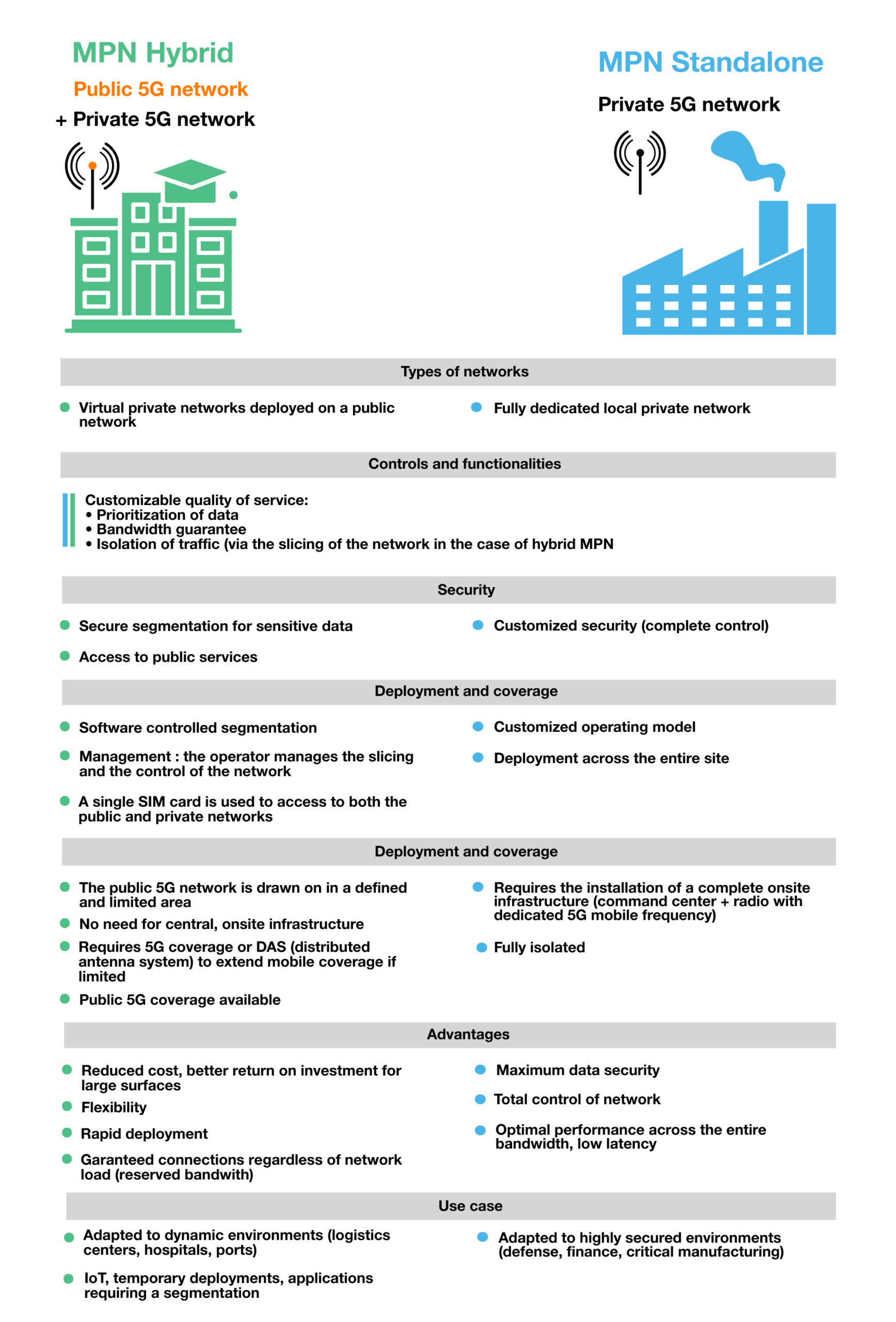
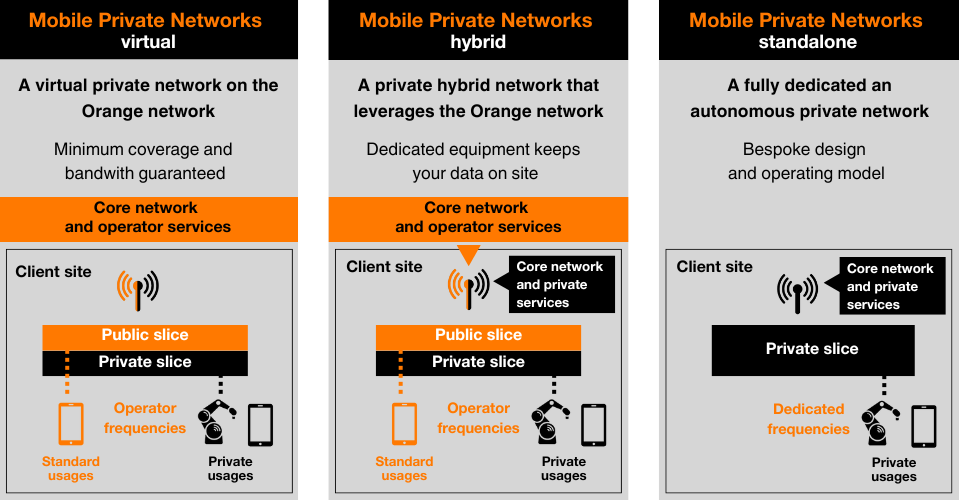
First is a hybrid MPN, which combines public and private 5G slices using the same antenna system and leverages the existing public 5G network. It requires minimal on-site infrastructure, isolates and secures locally sensitive data in addition to providing custom QoS, bandwidth guarantees and data prioritization via network slicing.
MPN Hybrid is flexible because it allows employees and visitors to use public 5G, while IoT devices and other business-critical equipment use a secure private 5G network slice. This approach is cost-effective and scalable, and suited to large campuses, logistics hubs, or ports.

For example, Orange, a partner in the “5G Metro” project conducted with the Université Côte d’Azur (via IMREDD) and Awabot, an expert in telepresence robotics applications, created a Hybrid MPN that enables one of the first integrated systems in Europe dedicated to inclusive education and robotics experimentation. Since mid-December 2025, and because digital use cases vary in high education and research, the indoor mobile coverage system provides full public and private 5G connectivity throughout the university’s Innovation and Partnerships Institute. For example, a student consulting the library catalog does not have the same connectivity needs as a robot that allows a remote student to attend a class in real time.
MPN Standalone
The second option is a standalone MPN. This is a dedicated private network that uses private spectrum rather than the public 5G network. It offers maximum control and isolation and is best for industries that have high levels of customization or regulatory requirements. Because MPN Standalone requires full infrastructure deployment for both the radio and core network, it can be more expensive and take longer to deploy.

An example of this approach is the Orange 5G MPN deployed at steel manufacturer (opens in a new window) Arcelor Mittal . Called 5G Steel, the ambitious project is key to the company’s digital transformation and decarbonization strategy. It supports several Industry 5.0 applications, such as driverless autonomous vehicles, enhanced monitoring and control of energy consumption through sensor data and safer operations in hazardous zones.
Increased control and functionality for different types of MPNs
Both MPN Hybrid and MPN Standalone offer increased control and functionality for enterprises looking to support their IoT offering. They allow for customizable QoS, including prioritization of data, bandwidth guarantees and isolation of sensitive traffic, via network slicing in the case of hybrid MPNs.
In general, hybrid MPNs are more cost-effective for large areas, while standalone networks are better suited to companies requiring fully customizable networks. Because hybrid MPNs integrate public and private networks on-site, they support multiple user profiles, such as public-only for visitors, private-only for IoT devices, and mixed for employees needing both.
Additionally, since network segmentation in hybrid MPNs is performed at the software level, devices require only a single SIM card to access both private and public networks. This flexibility makes them suitable for dynamic environments like logistics hubs, hospitals, and ports.
In terms of security, as a dedicated network, MPN Standalone provides the enterprise with complete flexibility over security levels. And for Hybrid MPNs, enterprises can create secure slices of the network for sensitive data while still allowing access to public services.
Deployment considerations
As a fully dedicated network, standalone MPNs require enterprises to acquire private spectrum for their projects.
In terms of equipment deployment, MPN Standalone requires full infrastructure installation of both core and radio networks. The network is fully isolated from public networks and requires on-premise orchestration. It is best suited for high-security environments, such as defense, finance and critical manufacturing, and offers maximum control, customization, and data sovereignty.
Because MPN Hybrid leverages the public 5G network, it doesn’t require on-site deployment of the Core Network, but only a User Plane Function to connect to both public and private networks and assigns data flows based on use cases. This architecture offers a CSR advantage by reducing the need for on-site infrastructure deployment, which minimizes environmental impact and lowers energy consumption..
Network slicing and control for hybrid MPNs is handled at the operator level, and as mentioned earlier just one SIM is needed for both private and public network slices. Of course, the site will need to be in the 5G coverage area for the system to work. If coverage is limited, Orange can extend mobile coverage inside an industrial campus through a Distributed Antenna System (DAS), ensuring seamless connectivity throughout the site.
How to choose between a hybrid or standalone 5G MPN?
Choosing the most appropriate 5G MPN for your environment depends on your use cases and your site. As both an operator and integrator, Orange can provide end-to-end solutions in network deployment for both hybrid and standalone 5G MPNs.
Orange has extensive experience in deploying 5G MPNs, with analyst Gartner placing us in the leader’s Quadrant of the 2025 Gartner® Magic Quadrant for 4G and 5G Private Mobile Network Services. (opens in a new window)
Orange 5G Lab supports all companies wishing to experiment with a 5G MPN, whether hybrid or standalone.
Want to know more about 5G MPNs?
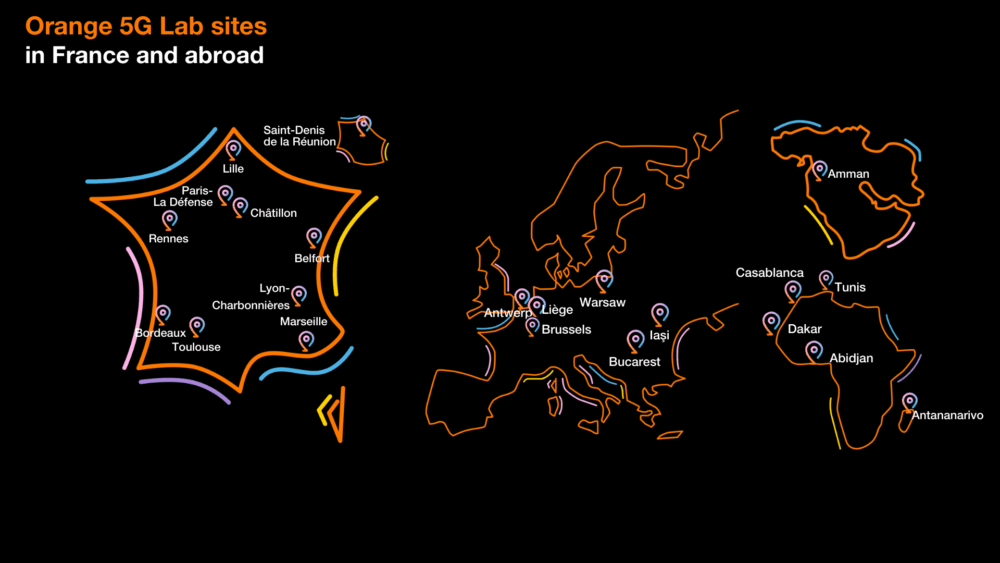
Orange 5G Lab, with 22 sites in France and abroad, supports all companies eager to experiment with 5G and fully harness its potential.
Through concrete and innovative solutions, we help them transform their businesses and anticipate tomorrow’s challenges.
Make an appointment with an Orange 5G Lab expert