Published : 03/12/2025

5mn reading time
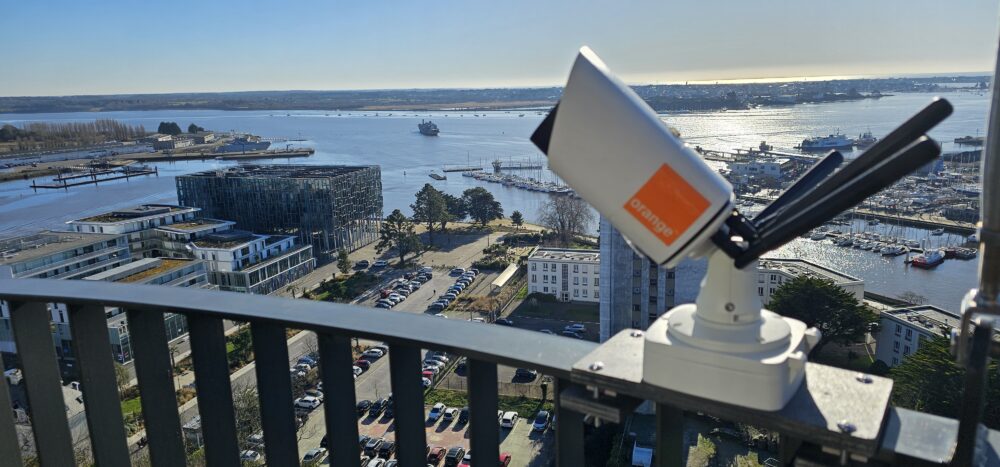
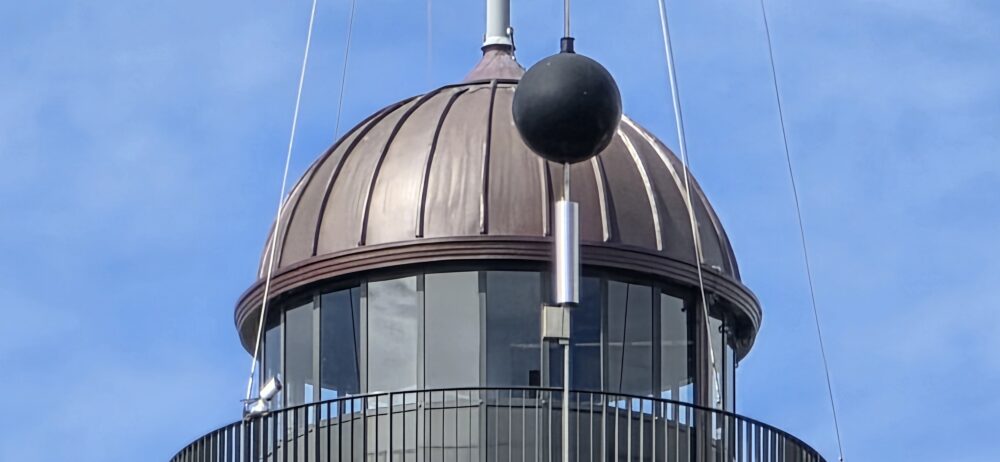
At the top of the Tower of Discovery, a founding symbol of the city of Lorient, a black ball falls every day at astronomical noon. This precise movement, once essential to navigators, has been brought back to life thanks to a restoration and a unique technological device. For over a year, a 5G camera installed by the Orange 5G Lab in Rennes has been monitoring this delicate mechanism at a height of nearly 40 metres and ensuring its proper functioning.
Crédits vidéo : Orange, La Ville de Lorient, Atom Studio AB Drone
The city of Lorient has experimented 5G

Sector of activity
Tourism

Business needs
The City of Lorient is seeking a solution to limit regular checks of the hourly ball system on the Tower of Discovery.

Solutions
Orange 5G Lab proposes to equip the tower with a 5G camera to monitor the time ball so that it only intervenes in the event of a malfunction.

Benefits of 5G
Camera activation only in case of movement and real-time image transmission via 5G.
Orange and the city of Lorient reinvent the Tower of Discovery with 5G
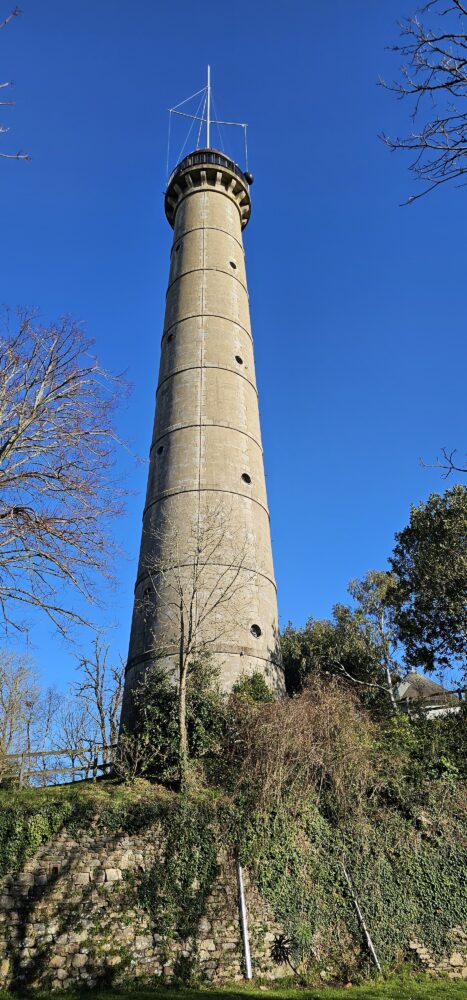
A unique heritage brought back to life
The Discovery Tower is not a monument like any other.
It is a monument built in the 18th century, which housed an observatory where naval officers – including Jules Verne’s brother! – studied astronomy and the stars,” says Christophe Deutsch-Dumolin, project manager for the City of Art and History in Lorient.
During its renovation, a major challenge arose: to reconstruct a functional hour globe, a device that is now unique in Europe.
Previously, a soldier would climb to the top of the tower to manually trigger the ball drop, then an electrified system was installed, recalls Christophe Deutsch-Dumolin. Today, the signal watcher has been replaced by a 5G webcam.
Although the city has invested in restoring the mechanism, it remains delicate and requires daily monitoring. This is where the 5G camera comes in.
An experiment between history and modernity
The restoration posed an unprecedented technological challenge: how to monitor a fragile device located at the top of a historic monument where there is only one electrical outlet? This is precisely what sparked the interest of the Orange 5G Lab teams. During a visit by the local authority to the 5G Lab, the discussion turned to local heritage.
The city wanted to promote a monument that was visible to all yet little known, located at the very heart of Lorient’s origins,‘ recalls Yann Ayral, Director of Local Authority Relations for Morbihan at Orange. ’When the Tour de la Découverte was mentioned, the idea came immediately: to test an autonomous 5G camera to monitor the clock tower..
On the surface, it may seem simple. But the technology is more sophisticated than it appears:
Technically, we defined an area to be monitored within the camera’s field of view where movements are detected. It’s quite sophisticated because it involves capturing, recording, time-stamping and computer vision to detect the ball’s movements as accurately as possible,” explains Jean-Jacques Gaouyer, Director of Innovation for Orange in Brittany and Pays de Loire and Head of the Orange 5G Lab in Rennes.
In practical terms, the experiment relies on a fully autonomous 5G camera that requires no network infrastructure, simply plugged into the only available power source. Thanks to 5G, the camera detects the ball’s movement at the exact moment it falls, records the event, time-stamps it, and alerts the teams in the event of an anomaly. Due to real-world conditions, the system even had to be adjusted to ignore seagulls and sun glare, which triggered alerts during the initial trials.
We are conducting a full-scale experiment, with constant challenges,” summarises Jean-Jacques Gaouyer.
A tool for smart tourism
Beyond its technical function, the 5G camera is a valuable tool for promoting heritage and enhancing the reputation of the city of Lorient..
This is the very idea of smart tourism, a bridge between history and modernity,” explains Jean-Jacques Gaouyer.
For Lorient, the benefit is twofold: on the one hand, securing a unique part of its heritage; on the other, the opportunity to position the city as a hub for technological experimentation. At every stage of the project, the Orange 5G Lab supported the city in every detail: installation, online interface, successive calibrations, user feedback, technical adjustments.
The role of the 5G Lab is to explore use cases, take a step back, and help businesses and local authorities test what 5G can change in practical terms,” explains Jean-Jacques Gaouyer.
And while it may seem modest, this use case opens up much broader prospects. From heritage buildings without connectivity to hard-to-access infrastructure and urban security, the solution tested in Lorient paves the way for multiple applications.
This opens up possibilities. I have no doubt that this model will be able to address other heritage or infrastructure issues,” says Christophe Deutsch-Dumolin.
We are testing a technology in an extreme use case, but one that could be used in many other contexts, in businesses or local authorities,” adds Yann Ayral.
This experiment is therefore not only proof of an effective technology: it marks the 5G Lab’s desire to support regions in their digital transition. Today, as the experiment draws to a close, the camera operates daily and discreetly, almost invisibly. The history of Lorient continues to be written at the pace of a system designed more than two centuries ago, now protected by 21st-century connectivity.
We continue to contribute to the history of science in a city that has historically always been at the forefront of progress,” summarises Christophe Deutsch-Dumolin.
An unlikely encounter between astronomy, heritage and 5G, reminding us that the most powerful innovation is sometimes the one that goes unnoticed.

Subscribe to our Orange 5G Lab newsletter